Table of Contents
A criminal case moves fast in Alaska. Within hours of a traffic stop on the Glenn Highway, Minnesota Drive, or a side street in Midtown Anchorage, a driver can be arrested, booked at the Anchorage Correctional Complex, released with a citation for AS 28.35.030, and left holding a Notice and Order of Revocation that starts a seven-day clock at the Alaska DMV. Two separate cases now run in parallel — a criminal prosecution in District Court and an administrative license action at the DMV — and both have to be defended.
A statute most drivers have never read. Alaska does not call the offense "DUI" or "DWI." AS 28.35.030 uses the term "operating under the influence," commonly abbreviated OUI. It covers alcohol, inhalants, and controlled substances, and it can be proven either by a chemical test result at or above the statutory threshold or by evidence of impairment without any specific number. That distinction opens up defenses on both the machine reading and the officer's observations.
BFQ Law defends OUI, refusal, and companion charges from our Anchorage office and appears throughout the Third Judicial District. If you or a family member has been arrested for OUI, cited under AS 28.35.030 or AS 28.35.032, or handed a Notice and Order of Revocation, you can reach us through our contact page or by emailing secretary@BFQLaw.com. Call for a confidential consultation.
This article is general legal information about Alaska OUI law and is not legal advice. Reading it does not create an attorney-client relationship with BFQ Law. Your case will turn on facts specific to you, and you should speak with a qualified Alaska criminal-defense attorney before making decisions that affect your rights.
What Alaska OUI Actually Is
The core statute. AS 28.35.030(a) makes it a crime to operate or drive a motor vehicle, aircraft, or watercraft while (1) under the influence of alcohol, an inhalant, or a controlled substance, or (2) while there is 0.08 percent or more by weight of alcohol in the person's blood, or eight-hundredths of a gram or more per 210 liters of breath. Commercial drivers cross the criminal threshold at 0.04 percent. The statute is written in the alternative — the State can prove OUI by the number, by the driver's condition, or both.
"Operating" is broader than driving. Alaska courts have applied AS 28.35.030 to drivers asleep behind the wheel with the engine running and to drivers in parking lots. Actual movement is not required if the driver had physical control and the ability to put the vehicle in motion. A driver who pulled off the road to sober up can still be charged if the keys are in the ignition.
"Under the influence" without a number. Even where a chemical test is unavailable or under the legal threshold, the State can proceed on an impairment theory. The officer's observations — driving pattern, coordination, speech, odor, eye movement, and SFST performance — become the evidence. Impairment cases often involve prescription medication, cannabis, or a combination of substances that do not produce a clean breath number, and they are cases where the defense has room to work because the proof rests on subjective observations rather than a machine.
Two Parallel Tracks: Criminal and DMV
One arrest, two proceedings. Every Alaska OUI arrest generates two independent cases: the criminal prosecution, filed by the State in the District Court for the Third Judicial District at Anchorage, and the administrative license action at the Alaska DMV under AS 28.15.165. The two proceedings apply different burdens of proof, follow different schedules, and are decided by different fact-finders. Winning one does not automatically win the other.
The 7-day DMV clock. When an officer arrests a driver for OUI and either obtains a chemical test result at or above 0.08 (0.04 for commercial drivers) or documents a refusal, the officer serves a Notice and Order of Revocation. That paper carbon is the only warning most drivers get. Under AS 28.15.165, the driver has seven calendar days from service to request an administrative hearing. Miss the seven days, and the revocation takes effect automatically and cannot be contested later.
Different schedules, different standards. The District Court arraignment happens within days of arrest, followed by pretrial conference, discovery, motions, and either a plea or a trial. The DMV hearing generally happens sooner, is conducted telephonically before a hearing officer, and is decided on a preponderance-of-the-evidence standard rather than beyond a reasonable doubt. Because the DMV case moves first, it is often the driver's earliest opportunity to test the officer's account under cross-examination.
Why both matter. A driver can beat the criminal charge and still lose the license administratively if the seven-day request was missed, or win the DMV hearing on a paperwork defect and still face conviction in the criminal case. Coordinating both tracks from day one is the entire point of hiring counsel quickly.
From Traffic Stop to Booking: What Actually Happens
The stop. Every OUI case begins with a lawful reason to pull the driver over — a traffic infraction, a report from another driver, or a checkpoint under a valid protocol. Under both the Fourth Amendment and Article I, Section 14 of the Alaska Constitution, the officer must have at least reasonable suspicion. If the stop was pretextual or unsupported, everything that followed can be challenged.
Standardized Field Sobriety Tests
The three-test battery. Anchorage officers use NHTSA's three standardized field sobriety tests: horizontal gaze nystagmus (HGN), walk-and-turn, and one-leg stand. Each has a specific administration protocol and scoring criteria, and deviation from protocol is a defense point. SFSTs are voluntary in Alaska; a driver can decline them without triggering the implied-consent penalty, which attaches only to the chemical test.
The Preliminary Breath Test (PBT)
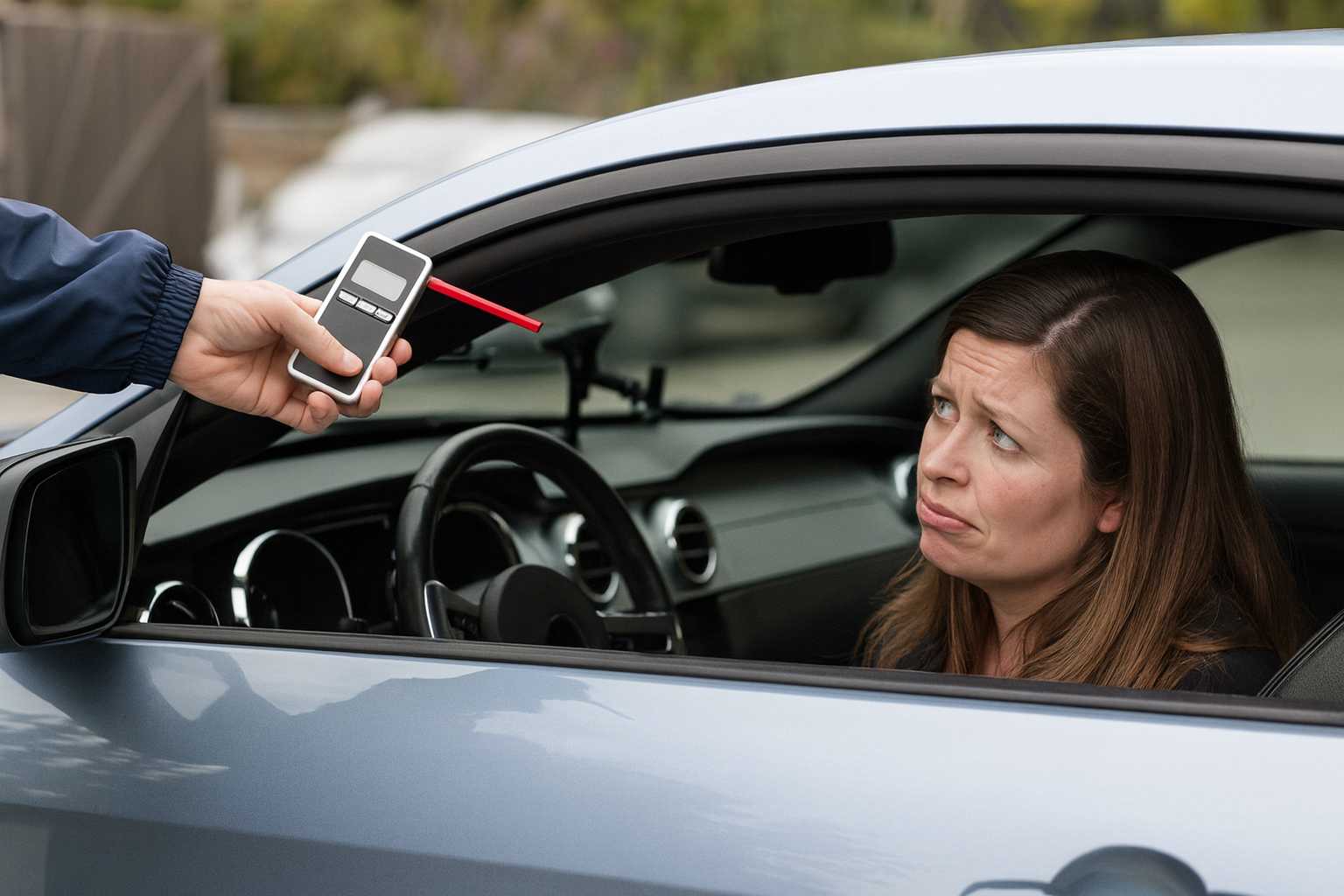
The handheld PBT at the roadside is a screening tool. Its result is not admissible at trial to prove the blood-alcohol number, only to establish probable cause for the arrest. The number the State will try to introduce is the evidentiary breath test conducted after arrest at the police station — a different device, a different procedure, and a different set of defense angles.
Implied Consent and the Station Test
Alaska's implied-consent law lives at AS 28.35.031. By driving on Alaska roads, every driver is deemed to have consented to a chemical test of breath or blood if arrested for OUI. The evidentiary breath test in Anchorage is typically the DataMaster DMT, administered by a certified operator after a mandatory observation period. The observation period, the calibration of the instrument, the operator's certification, and the two-sample agreement are all requirements — each one a potential defense issue if the record is incomplete.
Blood draws. Where a breath test is not appropriate — a serious injury, an unconscious driver, a suspected drug case — Alaska law provides for a blood draw. Warrantless blood draws generally require exigent circumstances or valid consent under the current constitutional framework; otherwise a warrant is needed.
Sentencing Tiers Under AS 28.35.030
A statute with escalators. AS 28.35.030 imposes graduated mandatory minimums that stack fast with each prior conviction. A first offense is a Class A misdemeanor under AS 12.55.135(a)(1). A fourth offense within the lookback window becomes a Class C felony under AS 28.35.030(n). The mandatory minimums are exactly that — the court cannot suspend the required jail time or fine, and the license consequences are separate from the jail consequences.
Minimum penalties by offense number:
- First offense. Minimum 72 hours of jail, a $1,500 fine, a 90-day license revocation, mandatory alcohol screening, and ignition interlock upon relicensure.
- Second offense within 15 years. Minimum 20 days of jail, a $3,000 fine, a one-year license revocation, and ignition interlock.
- Third offense within 15 years. Minimum 60 days of jail, a $4,000 fine, a three-year license revocation, and ignition interlock.
- Fourth or subsequent offense — felony. Charged as a Class C felony under AS 28.35.030(n), with a presumptive sentencing range in the Alaska Superior Court, permanent license revocation, and mandatory ignition interlock upon any future relicensure.
The 15-year lookback. AS 28.35.030 uses a rolling 15-year window to determine whether a prior counts for misdemeanor enhancement. A prior older than 15 years generally does not trigger the escalators for a new misdemeanor charge. The felony provision under AS 28.35.030(n) counts prior convictions differently, and older convictions can still contribute to a felony charge. A misclassification of the prior changes both the charge and the mandatory minimum.
Refusal Charges Under AS 28.35.032
Refusing does not avoid the case. AS 28.35.032 makes it a separate crime to refuse the chemical test after arrest for OUI. The refusal charge carries mandatory minimums that mirror OUI — the same 72 hours on a first offense, the same 20 days on a second within 15 years. A driver who refuses can end up facing two related charges from the same stop: the underlying OUI (proven on impairment evidence alone) and the refusal (proven by the officer's testimony that the test was requested and declined).
The DMV consequence is worse. AS 28.15.165 imposes tiered refusal revocations that generally exceed the equivalent OUI revocation. Refusal is treated as an aggravating administrative event, not a shortcut around one.
Losing Your License: Revocation and Relief
Two revocations from one arrest. A driver convicted of OUI can face two overlapping revocations — one imposed administratively under AS 28.15.165 and one imposed by the criminal court under AS 28.35.030. The statutes require the periods to run concurrently in most situations, but the administrative revocation takes effect while the criminal case is still pending.
The Limited License Under AS 28.15.201
Alaska allows a limited license — sometimes called a hardship license or work permit — under AS 28.15.201. Eligibility depends on the offense number, whether the driver has completed alcohol screening, and whether an ignition interlock device has been installed. The limited license typically restricts driving to work, medical appointments, court-ordered treatment, and documented family obligations, along a specific route. It is not a full license, it is not automatic, and it is often unavailable during the first portion of the revocation period, particularly for refusal-based revocations.
Ignition Interlock Under AS 28.35.028
The ignition interlock device (IID) requirement under AS 28.35.028 attaches to nearly every OUI relicensure. The court sets duration by offense number: several months for a first offense, longer for subsequent offenses, and up to a lifetime period in aggravated felony cases. The device is installed at the driver's expense on any vehicle the driver operates, and the monthly reporting data is reviewed by the DMV. A missed calibration, a positive breath sample, or an attempted circumvention can extend the required period or trigger separate criminal exposure.
Commercial Drivers and the CDL
CDL holders face substantially harsher outcomes. A first OUI conviction disqualifies a CDL for a mandatory one-year period under federal regulations that Alaska has adopted. A second offense is a lifetime CDL disqualification. A CDL holder charged with OUI in a personal vehicle still loses the commercial license — there is no limited or hardship CDL.
Real Defenses in an Alaska OUI Case
Defenses exist at every stage. An OUI case is a chain of independent legal events, each of which the State has to prove and each of which can be challenged. Cracking any single link often changes the case.
Reasonable Suspicion and Probable Cause
Every OUI case starts with the reason the officer pulled the driver over. If the stop rested on vague "weaving within the lane," an unverified anonymous tip, or a mistake about traffic law, the entire case can be challenged under the exclusionary rule. A lawful stop then has to escalate to probable cause before a valid arrest. SFST performance, odor, and the PBT result together support arrest, but each element has weaknesses — medical conditions, fatigue, footwear, terrain, cold weather, and prior injuries all confound SFST scoring. If the arrest was made without probable cause, the chemical test that followed can be suppressed as fruit of the unlawful arrest.
The Observation Period and the Breath Machine
The DataMaster requires an uninterrupted observation period, usually 15 minutes, during which the driver cannot burp, regurgitate, put anything in the mouth, or introduce residual mouth alcohol. Any belch, hiccup, or unmonitored moment can invalidate the test. Beyond the observation period, the instrument itself has calibration logs, control tests, and certification records — comparison against the specific instrument's history routinely produces defense points.
Medical Conditions, GERD, and Diet
Gastroesophageal reflux disease (GERD), hiatal hernia, and certain diabetic conditions can push mouth alcohol or acetone into the breath sample and inflate the reading. A driver on a ketogenic diet produces isopropanol that some instruments misread. Recent dental work, oral piercings, and certain mouthwashes contribute alcohol readings that were never in the driver's bloodstream. Medical documentation matters and should be preserved early.
The Rising Blood Alcohol Defense
Alcohol continues to absorb into the bloodstream after the last drink. A driver who was under 0.08 while driving can register above 0.08 an hour later at the station. The State's burden under AS 28.35.030 is to prove the level at the time of driving, not at the time of testing. Expert testimony on absorption pharmacokinetics can turn a machine reading against the State.
Chain of Custody on Blood Draws
Blood cases raise a distinct set of challenges. Who drew the blood, under what medical order, which preservative was in the vial, how the vial was stored between the draw and the lab, whether the lab followed a validated gas chromatography protocol — the State has to establish each link, and defense counsel should audit every one.
Miranda and Post-Arrest Statements
Statements made after arrest and before Miranda warnings can be suppressed, and Alaska's constitution provides slightly broader protection than the federal Fifth Amendment in some scenarios. Drivers who told the officer how many drinks they had or what medication they take should not assume those statements will come in at trial.
The First 72 Hours: What to Do (and Not Do)
The first three days determine a lot. Evidence gets preserved or lost, the DMV clock starts running, and statements are made or avoided. The choices made in the first 72 hours carry through the rest of the case. Priority actions in the first seven days:
- Request the DMV hearing within seven days. This is the single most time-critical step. The Notice and Order of Revocation itself explains how to request the hearing. Do it in writing and keep proof of submission.
- Do not talk about the case. Not with friends, not on social media, not on the phone from custody (calls are recorded), not with insurance representatives.
- Write down everything while it is fresh. The route driven, the reason for the stop as the officer described it, the times, what was said, medical conditions, medications taken that day, and the last meal.
- Preserve receipts and video. Restaurant receipts, ATM slips, dashcam footage, and text messages showing the timeline can corroborate or refute the State's version.
- Locate a criminal-defense attorney immediately. Arraignment happens fast, discovery has to be requested, motions have deadlines, and the DMV hearing has to be prepared.
- Save the release paperwork. The citation, the Notice and Order of Revocation, and the property inventory sheet contain case numbers and dates counsel will need.
- Note any medical or dietary factors. Diabetes, GERD, recent surgery, prescription medications, ketogenic diet, and dental work can each affect the chemical test or SFST performance. Document them contemporaneously.
What not to do. Do not post about the arrest online, contact the arresting officer to explain, or miss the arraignment. And do not assume the case will sort itself out because you believe the test was wrong. Alaska OUI cases do not sort themselves out; they are litigated.
Frequently Asked Questions
Is Alaska a "DUI" state or a "DWI" state?
Neither, technically. Alaska's statute uses "operating under the influence," abbreviated OUI. AS 28.35.030 is the controlling section. "DUI" is a widely used shorthand, but the offense of record is OUI. The distinction is more than semantic — "operating" (rather than "driving") widens the reach of the statute to physical control of a vehicle without actual movement, which is why sleeping-in-the-driver's-seat cases can still be prosecuted.
Can I refuse the breath test? What happens?
You can physically decline, but Alaska law treats refusal as a separate crime under AS 28.35.032, with mandatory minimums that mirror OUI itself. Refusal also triggers a longer license revocation under AS 28.15.165 than a failed test would, and the underlying OUI can still be proven on the officer's observations even without a chemical number. Refusal is rarely a strategic win, and the assumption that "no number means no case" is inaccurate.
I already lost my license at the DMV. Does the criminal case still matter?
Yes — significantly. A conviction under AS 28.35.030 creates a permanent criminal record, mandatory jail time, a fine, ignition interlock exposure, probation, insurance surcharges, and cascading effects on employment, professional licensing, and immigration status. Winning the criminal case also protects eligibility for future limited licenses and can prevent a subsequent arrest from being charged as a "second offense." It matters even if the DMV process has already moved.
Is a first-offense Alaska OUI a felony?
No. A first-offense OUI is a Class A misdemeanor under AS 12.55.135(a)(1), with mandatory minimums of 72 hours in jail, a $1,500 fine, and a 90-day license revocation. It does not become a felony absent aggravating facts such as a serious-injury or fatal collision, which are charged under separate statutes with their own penalty ranges. Felony OUI applies to the fourth or subsequent qualifying conviction under AS 28.35.030(n). A Class A misdemeanor conviction is still a criminal conviction with lasting consequences.
How long does a DUI stay on my Alaska driving record?
Permanently, for AS 28.35.030 counting purposes. Alaska does not expunge OUI convictions from the criminal record. A misdemeanor conviction from ten or twenty years ago will still appear on background checks. The 15-year lookback controls whether a prior counts to enhance a new misdemeanor charge, but the felony provision under AS 28.35.030(n) counts prior convictions more broadly, and a decades-old conviction can still contribute to a felony charge in the right circumstances. Assume the record is permanent.
Can I get a limited license so I can keep working?
Possibly, under AS 28.15.201. A limited license typically authorizes driving to and from work, medical care, court-ordered treatment, and documented family obligations. Eligibility depends on the offense number, whether the revocation is refusal-based (which delays eligibility), completion of an alcohol screening, and installation of an ignition interlock device. It is not immediate and is not available for CDL holders on their commercial license.
What is the "15-year lookback"? Does it apply to felony charges?
The 15-year lookback is the window AS 28.35.030 uses to decide whether a prior conviction counts to enhance a new misdemeanor from first-offense penalties into second- or third-offense penalties. A prior outside that window generally does not enhance a new misdemeanor. The felony provision under AS 28.35.030(n), however, uses its own counting framework and can reach further back — older convictions can still contribute to felony exposure. Anyone with prior convictions should have counsel read the record before pleading to a new charge.
Do I need an attorney at the DMV hearing?
Technically no, but functionally yes. The hearing officer applies a preponderance standard, the arresting officer's sworn report is generally admitted without live testimony unless counsel subpoenas the officer, and the issues are narrowly defined. Unrepresented drivers frequently lose hearings they could have won because they did not subpoena the officer, did not identify the correct issues, and did not preserve the record for appeal. The hearing is also the driver's earliest chance to lock in the officer's testimony under cross-examination — testimony that can then be used in the criminal case.
Talk to a BFQ Law Defense Lawyer
An OUI charge in Alaska is not a fine and a court date. It is a criminal prosecution under AS 28.35.030 that runs alongside an administrative license action under AS 28.15.165 — with mandatory jail time, a permanent record, a lookback that can convert a future arrest into a felony, ignition interlock exposure under AS 28.35.028, and cascading consequences for employment and insurance. The seven-day DMV clock starts at the roadside, and the choices made in the first days after arrest constrain every option that follows.
Defenses are real when the case is worked. Stops without reasonable suspicion, arrests without probable cause, incomplete instrument records, unclear chain of custody, observation-period violations, medical explanations, rising-BAC pharmacokinetics, and pre-Miranda statements can each move a case. Whether they move any particular case depends on the facts and the file.
BFQ Law defends OUI, refusal, and companion charges from our Anchorage office and appears throughout the Third Judicial District. If you have been arrested, cited, or served with a Notice and Order of Revocation, reach us through our contact page or by emailing secretary@BFQLaw.com. Call for a confidential consultation. The seven-day DMV window does not wait.
Need Legal Help?
If you have questions about criminal defense or need legal representation, contact BFQ today for a free consultation.
Schedule Free ConsultationLearn more about our Criminal Defense practice.